
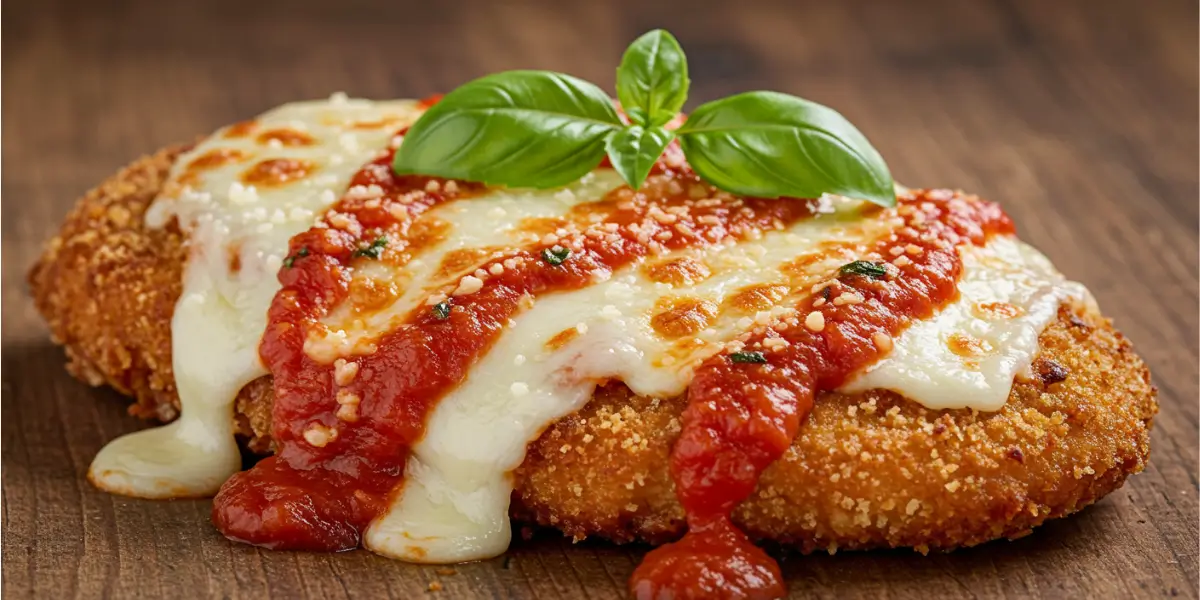
There are few dishes in this world that offer the same profound comfort as a perfectly executed Chicken Parmesan. Can you recall the sound? That satisfying crunch as your fork breaks through a golden, crispy crust, giving way to tender, juicy chicken, all smothered in bubbling, savory marinara and stretchy, melted cheese. It’s the star of Italian-American menus for a reason, but it’s also a dish that so many home cooks struggle to perfect. Too often, it arrives at the table soggy, greasy, or bland. But what if I told you that the Chicken Parmesan of your dreams—the one that rivals your favorite trattoria—is absolutely within your reach?
I remember the first time I nailed this recipe. It was for a big family dinner, and the pressure was on. That triumphant moment when I pulled the baking dish from the oven, seeing that glorious, cheese-crusted masterpiece, and heard the collective “oohs” and “aahs” from my family… that’s the feeling I want for you. This isn’t just another Chicken Parmesan recipe; it’s a guide to creating a masterpiece. We’re going to dive deep into the science, the techniques, and the little secrets that transform simple ingredients into a legendary meal. So, tie on your apron, and let’s create some magic.
Why This Chicken Parmesan Recipe is a Game-Changer
This particular approach to Chicken Parmesan is built on a foundation of tested techniques. We’re not just throwing ingredients together; we’re engineering a perfect bite every single time. Understanding the “why” behind the steps is what will make your Chicken Parmesan stand out from the rest.
The Secret to a Crispy, Not Soggy Crust
The number one enemy of a great Chicken Parmesan is a soggy breadcrumb coating. The culprit? Steam and moisture from the sauce and chicken. Our defense is a three-part strategy: a thorough dredging process, a quick pan-sear to lock in the crispness before baking, and a strategic assembly that creates a protective barrier between the chicken and the sauce.
Why Your Cheese Choice Matters
Not all cheeses are created equal, especially when it comes to Chicken Parmesan. Pre-shredded bags of “mozzarella” are often coated with anti-caking agents that prevent them from melting into that iconic, stretchy blanket. For the best results, you need fresh, low-moisture mozzarella that you shred yourself. And for the Parmesan, always opt for a wedge of real Parmigiano-Reggiano that you grate fresh. The flavor difference is astronomical.
Baking vs. Frying: The Great Debate Solved
While traditionally fried, our Chicken Parmesan recipe uses a hybrid method for the best of both worlds: a quick pan-fry to achieve an irreplaceably crispy, golden-brown crust, followed by a finish in the oven to cook the chicken through gently and melt the cheese without burning the breading. This method is less messy, healthier, and yields a superior texture compared to fully baking or fully frying.
Gathering Your Chicken Parmesan Ingredients
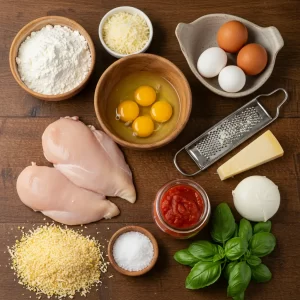
Quality in, quality out. Using the best ingredients you can access is the first step toward an unforgettable Chicken Parmesan. Here’s a detailed breakdown of what you’ll need.
The Chicken: To Pound or Not to Pound?
For even cooking and a tender bite, pounding your chicken is non-negotiable. Using the flat side of a meat mallet or a heavy skillet, gently pound boneless, skinless chicken breasts to an even ½-inch thickness. This step ensures your Chicken Parmesan cooks evenly and prevents the thinner edges from burning while the thicker center remains raw.
The Breading Station: Your Three-Step Assembly Line
A proper breading station is the heart of a great crust. You’ll need three shallow dishes: one for all-purpose flour (seasoned with salt and pepper), one for beaten eggs (a splash of water can help), and one for a mixture of breadcrumbs. For the best Chicken Parmesan, use a 50/50 mix of Panko and traditional Italian-style breadcrumbs. The Panko provides an airy, crisp texture, while the Italian breadcrumbs add flavor.
The Saucy, Cheesy Toppings for Maximum Flavor
Your sauce doesn’t need to be homemade, but it should be good quality. Taste a few jarred marinara sauces and find one you love. For cheese, as mentioned, fresh is best. You’ll need about 8 ounces of low-moisture mozzarella and 1 cup of freshly grated Parmesan. Don’t forget fresh basil or parsley for a bright, fresh finish!
Here is a quick-reference table for your shopping list:
Table 1: Chicken Parmesan Ingredient Breakdown
| Category | Ingredients | Notes & Pro Tips |
|---|---|---|
| The Chicken | 2 large boneless, skinless chicken breasts | Halved horizontally or pounded to ½-inch thickness. |
| The Breading | 1 cup all-purpose flour, 2 large eggs, 1 cup Panko, 1 cup Italian breadcrumbs, ½ cup grated Parmesan, Salt & Pepper | Season each component for layered flavor. |
| The Toppings | 2 cups marinara sauce, 8 oz low-moisture mozzarella (shredded), ½ cup freshly grated Parmesan, Fresh basil or parsley | Shred your own mozzarella for optimal melt. |
How to Make Chicken Parmesan: A Step-by-Step Guide
Now for the main event. Follow these steps carefully, and you will be rewarded with the best Chicken Parmesan you’ve ever made.
Step 1: Prepping the Chicken for Perfection
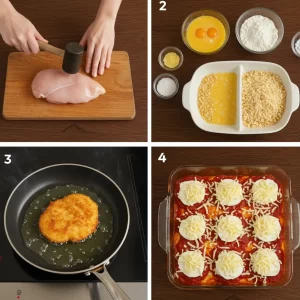
Pat your chicken breasts completely dry with paper towels. This is crucial for the breading to stick. Place them between two sheets of plastic wrap and pound to an even ½-inch thickness. Season both sides generously with salt and pepper. Set up your three-stage breading station: flour in one dish, beaten eggs in the second, and the combined Panko, Italian breadcrumbs, and ½ cup of Parmesan in the third.
Step 2: Mastering the Breading Process
Working with one hand for dry ingredients and one for wet can help prevent clumping. Dredge each chicken cutlet in the flour, shaking off any excess. Then, dip it completely in the egg wash, allowing the excess to drip off. Finally, press the chicken firmly into the breadcrumb mixture, ensuring a complete, even coating. Place the breaded cutlets on a wire rack for 5-10 minutes to let the coating set.
Step 3: Assembling and Baking to Golden-Brown Bliss
Preheat your oven to 425°F (220°C). In a large, oven-safe skillet, heat ¼ inch of olive oil over medium-high heat. Once the oil shimmers, carefully add the chicken (don’t overcrowd) and cook for 2-3 minutes per side, until golden brown. They will not be cooked through. Remove the chicken and place it back on the wire rack.
Pour about 1 cup of marinara sauce into the bottom of a 9×13 baking dish. Place the golden-brown chicken cutlets in a single layer over the sauce. Spoon the remaining sauce over the center of each cutlet, then top with the shredded mozzarella and remaining Parmesan. Bake for 15-20 minutes, until the cheese is melted, bubbly, and slightly spotted with gold. If you want more color, broil for the last 1-2 minutes, watching closely. Let it rest for 5 minutes before serving, then garnish with fresh basil.
Serving and Savoring Your Perfect Chicken Parmesan
You’ve done the hard work; now it’s time to enjoy the masterpiece. A great Chicken Parmesan deserves the perfect accompaniments.
The Best Pasta Pairings for Your Chicken Parmesan
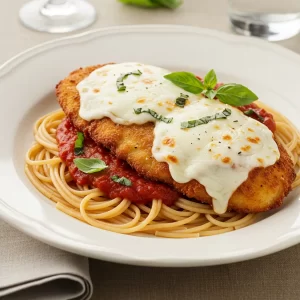
The classic pairing is, of course, spaghetti. Toss it with a little of the extra marinara sauce and a knob of butter. However, this Chicken Parmesan also shines alongside fettuccine, linguine, or a sturdy rigatoni that can catch all the delicious sauce and cheese. Don’t forget a final sprinkle of fresh Parmesan over the pasta.
Beyond Spaghetti: Creative Serving Ideas
Think outside the box! Your Chicken Parmesan makes an incredible sandwich on a toasted hoagie roll. You can also slice it and serve it over a bed of fresh arugula with a lemony vinaigrette for a lighter take. Or, for a low-carb option, serve it alongside zucchini noodles or a simple, crisp Caesar salad.
How to Store and Reheat Leftovers
Store leftover Chicken Parmesan in an airtight container in the refrigerator for up to 3 days. To reheat, avoid the microwave, which will make it soggy. Instead, place it on a baking sheet and warm it in a 350°F (175°C) oven for 10-15 minutes, or until heated through and the crust is crisp again.
Table 2: Baking vs. Frying Chicken Parmesan
| Method | Pros | Cons | Best For |
|---|---|---|---|
| Pan-Fry & Bake (Our Method) | Ultimate crispy texture, less oil than full frying, even cooking, beautiful presentation. | Requires two cooking vessels (skillet & baking dish). | The perfect balance of texture, health, and flavor. |
| Shallow Frying Only | Very crispy crust, fast. | Can be greasy, requires careful temperature control, can burn easily. | Purists who don’t mind the extra oil. |
| Baking Only | Healthiest, easiest, least messy. | Highest risk of a soggy crust, lacks the deep golden color. | A quick, weeknight, health-conscious version. |
Conclusion
Creating the ultimate Chicken Parmesan is a journey of simple, yet deliberate steps. From pounding the chicken for even tenderness to mastering the three-stage breading and using the hybrid cooking method, each technique builds upon the last to create a dish that is truly greater than the sum of its parts. You now hold the knowledge to consistently produce a Chicken Parmesan that is crispy, juicy, cheesy, and deeply satisfying—a centerpiece meal that will have your friends and family asking for the recipe every single time.
The only thing left to do is to try it for yourself. Gather those ingredients, trust the process, and get ready to experience Chicken Parmesan in a whole new light. I’d love to hear about your success! Share your photos and stories in the comments below, and let me know what your favorite pasta pairing is.
Frequently Asked Questions (FAQ)
Q1: What is the absolute best cheese combination to use for Chicken Parmesan?
For the most authentic and delicious Chicken Parmesan, the best cheese combination is freshly shredded, low-moisture mozzarella for that iconic melt and stretch, paired with high-quality, freshly grated Parmigiano-Reggiano for its sharp, nutty, salty flavor. Avoid pre-shredded cheeses, as they contain starches that inhibit melting.
Q2: How can I make a lighter, healthier version of Chicken Parmesan?
You can create a lighter Chicken Parmesan by baking the breaded chicken cutlets on a wire rack set over a baking sheet at 400°F (200°C) for 15-20 minutes (flipping halfway) instead of pan-frying. Use part-skim mozzarella, reduce the amount of cheese slightly, and serve it over a large salad or with steamed vegetables instead of pasta.
Q3: Can I prepare Chicken Parmesan ahead of time for a dinner party?
Absolutely! You can bread the chicken cutlets and refrigerate them for up to 24 hours before cooking. You can also fully assemble the Chicken Parmesan in the baking dish, cover it tightly, and refrigerate it for up to 8 hours before baking. You may need to add a few extra minutes to the baking time if it’s going into the oven cold from the fridge.